
I write this blog with a bit of feigned optimism, knowing how precarious the recent acceleration in AI and energy demand can be. The rapid expansion of data centres is one of the most consequential developments in today’s energy transition. Driven by artificial intelligence, cloud computing, and digital services across all sectors of the economy, data centres are now emerging as a significant source of new electricity demand. How this demand is met will have material consequences for climate targets, energy security, and infrastructure planning over the coming decades.

According to the International Energy Agency, electricity consumption from data centres is expected to more than double by 2030, reaching approximately 945 TWh, roughly equivalent to the current electricity consumption of Japan (IEA, 2025). The IEA identifies AI workloads as the single most important driver of this increase. Longer-term outlooks reinforce this trajectory. BP’s Energy Outlook suggests that data centres, driven largely by AI, could account for around 10% of global electricity-demand growth by 2035, and as much as 40% of demand growth in the United States (BP, 2025).
Taken together, these projections indicate that the digital transition is now structurally linked to the evolution of energy systems. Whether this expansion accelerates decarbonisation or reinforces fossil lock-in depends less on the technology and more on how data centres are integrated into energy systems.
Two paths for the growing energy demand
One possible path reflects a reactive response to rising demand. In several regions, utilities are meeting data-centre growth by expanding gas-fired generation. We see a sharp increase in orders for large gas turbines in the United States as utilities seek to secure capacity for AI-driven loads (Financial Times, 2025). Since gas infrastructure typically has a lifespan measured in decades, this approach risks locking in emissions well beyond the time horizons implied by national climate commitments. Academic research and policy analysis caution that, in the absence of deliberate planning, data-centre expansion can come into conflict with decarbonisation efforts, grid stability, and local sustainability goals (Huang et al., 2020; Sovacool et al., 2022).
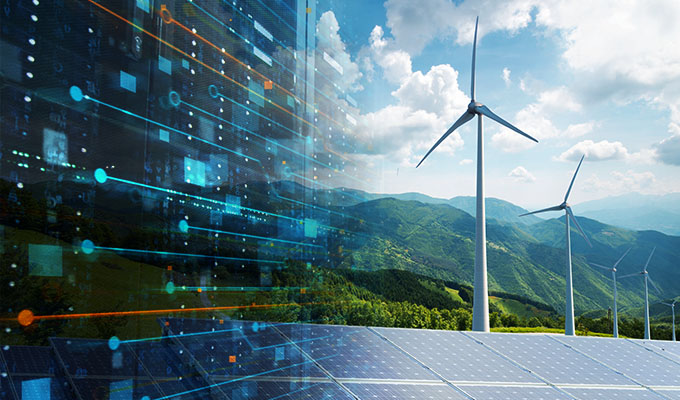
An alternative path sees data centres more than large electricity consumers, as potential anchors for cleaner energy systems. Hyperscalers are already among the world’s largest corporate buyers of renewable electricity, using long-term power purchase agreements for wind and solar to support their operations. When aligned with grid planning and policy frameworks, these investments can accelerate renewable deployment rather than repurposing existing supply (IEA, 2025).
Equally important under this path is the thermal dimension. Nearly all the electricity consumed by data centres ultimately becomes heat. Academic reviews show that when this waste heat is captured and integrated into district-heating networks, it can significantly improve overall system efficiency, reduce emissions from heating, and lower operational costs for both utilities and data-centre operators (Huan et al., 2020; Yuan et al., 2025). This is especially relevant in countries with established district-heating infrastructure.
Finland as a reference case
Finland offers a clear empirical example of this system-level integration. In the capital’s metropolitan area, Microsoft is developing data centres designed from the onset to recover waste heat and feed it into Fortum’s district-heating network. Fortum estimates that once fully operational, waste heat from these facilities could supply around 40% of the district-heating demand of its customers in Espoo, Kauniainen, and Kirkkonummi, contributing approximately 2–3% of Finland’s required national emissions reductions (Fortum, 2024).
Similarly, Helsinki’s municipal energy company, Helen, has been recovering waste heat from data centres for more than a decade. Its long-running collaboration with Equinix demonstrates that heat reuse can operate reliably at scale in dense urban contexts. Recent expansions are expected to provide sufficient recovered heat to cover the annual demand of roughly 1,500 one-bedroom apartments (Equinix, 2024).
These projects show that data centres can be planned as integrated parts of urban energy systems instead of isolated electricity sinks. However, they also depend on broader developments in energy infrastructure that extend beyond the data-centre sector itself.

Data Center’s as an integrated part of urban energy systems (Danfoss, n.d.)
Adjacent innovations and system pressure
Finland’s wider energy ecosystem illustrates how rising electricity demand can create incentives for systemic innovation. Thermal energy storage technologies, such as the sand batteries developed by Polar Night Energy, allow surplus heat to be stored and deployed over extended periods. The 100 MWh installation in Pornainen, for example, can supply weeks of local heating demand in summer and substantially reduce emissions from district heating.
While not developed specifically for data centres, the same storage principles are directly relevant for managing recovered waste heat at scale. Large, continuous data-centre loads put pressure on energy systems to expand renewable generation, strengthen grids, and improve the utilisation of heat and energy flows. In this sense, data-centre growth may act as a catalyst for cleaner energy systems—but only if governance frameworks ensure that system-wide efficiencies are pursued.
Governance as the deciding factor
The Finnish experience demonstrates that outcomes are shaped by technological feasibility, but more decisively, by coordination across actors. Regulators influence siting decisions (location planning of data centres), system boundaries, and performance metrics. Municipalities shape how data centres connect to heat networks and urban infrastructure. Utilities determine whether recovered heat and flexible loads are treated as assets. Data-centre operators ultimately decide where and how facilities are built.
When these elements align, data centres can reinforce renewable deployment, support district heating, and strengthen energy-system resilience. When they do not, the same growth risks deepening fossil-fuel dependence and infrastructure bottlenecks.
As AI and digital services continue to expand, the more important question is whether this pressure is used to accelerate cleaner, more integrated energy systems, or whether it results in reactive investments that slow the transition. Finland suggests that the former is possible when system integration, circularity, and governance are taken seriously from the outset.
More broadly, the pressures created by rising energy demands, coupled with increasing sustainability integration in infrastructure markets, can open new opportunities for B2B innovation and commercialisation. Companies like Nordic Ren-Gas, a partner in Hanken’s Green Growth Business Finland research project, illustrate this dynamic through the production of renewable e-methane and hydrogen using wind power and captured CO₂, at the same time feeding surplus heat into district-heating networks. Although operating outside the data-centre sector, such solutions reflect the type of integrated sustainability offerings increasingly demanded in B2B markets and raise important questions on how such sustainability innovations can scale and commercialise.
References
bp. (2025). Energy Outlook: 2025 edition. bp p.l.c. Retrieved from https://www.bp.com/en/global/corporate/energy-economics/energy-outlook.html
Equinix. (2024, October 17). More Helsinki homes to be heated using excess heat from Equinix data center. Equinix Newsroom. Retrieved from https://newsroom.equinix.com/2024-10-17-More-Helsinki-homes-to-be-heated-using-excess-heat-from-Equinix-data-center
Financial Times. (2025, October 22). The fallout from the AI-fuelled dash for gas. Financial Times. Retrieved from https://www.ft.com/content/dfd87d3d-a386-4706-a4ba-9f9274760111
Fortum. (2024). Microsoft X Fortum: Energy unites businesses and societies. Fortum Corporation. Retrieved from https://www.fortum.com/media/2024/03/microsoft-x-fortum-energy-unites-businesses-and-societies
Huang, P., Copertaro, B., Zhang, X., Shen, J., Löfgren, I., Rönnelid, M., et al. (2020). A review of data centers as prosumers in district energy systems: Renewable energy integration and waste heat reuse for district heating. Applied Energy, 258, 114109. https://doi.org/10.1016/j.apenergy.2019.114109
International Energy Agency. (2025). Energy and AI. IEA. https://www.iea.org/reports/energy-and-ai IEA
Nordic Ren-Gas Oy. (n.d.). Tampere: Clean Power-to-Gas fuel production and CO₂-free district heating plant planned in Tampere Tarastenjärvi. Ren-Gas projects. Retrieved from https://ren-gas.com/en/projekti/tampere-2/ Ren-Gas Oy
Polar Night Energy. (2022). World’s first Sand Battery. Polar Night Energy. Retrieved from https://polarnightenergy.com/reference/worlds-first-sand-battery/ Polar Night Energy
Sovacool, B. K., Upham, P., & Monyei, C. G. (2022). The “whole systems” energy sustainability of digitalization: Humanizing the community risks and benefits of Nordic datacenter development. Energy Research & Social Science, 88, 102493. https://doi.org/10.1016/j.erss.2022.102493 ScienceDirect+1
Yuan, X., Liu, J., Sun, S., Lin, X., Fan, X., Zhao, W., & Kosonen, R. (2025). Data center waste heat for district heating networks: A review. Renewable and Sustainable Energy Reviews, 219, 115863. https://doi.org/10.1016/j.rser.2025.115863 research.aalto.fi+1
Fares Georges Khalil, PhD
Doctor of Business Administration, Postdoctoral Associate at Hanken School of Economics